Friday, 30 November 2012

On reflection


It’s hard to imagine a child making their was through the Australian school system who isn’t au fait with the ANZAC story and my schooling experience was no exception, learning about Simpson and his donkey, the ineptness of the command, the bravery of the Australian and New Zealand diggers and the futility of the campaign. 

In doing so you build your own mental picture of what it would have been like at ANZAC Cove as the troops came ashore on 25 April 1915.  In later years I always thought the harrowing start of ‘Saving Private Ryan’ must be something akin to the chaos described of the initial landing. It was interesting then on our visit to the Gallipoli Peninsula to come face to face with the subconscious mental picture and context I’d built up overtime around the ANZAC story.

During our time at the Turkish Military History Museum we’d been fortunate to happen upon the room dedicated to the battle for control of the Dardanelles and the ensuing Gallipoli Peninsula conflict at the same time as a group of big wigs from the American services were being shown a short film on the campaign by their Turkish hosts.  As we silently made our way amongst them it was evident that the piece wasn’t on the land battle of Australian focus, but rather the successful naval campaign of 18 March 1915 against the English and French for control of the Dardanelles that preceded the Gallipoli landing.

The Dardanelles from the Gallipoli Peninsula
More than this however, and something I hadn’t really thought too much about, is that in the context of their history the successful defense of the Dardanelles was at the time a tremendous victory for the Turks over the powers of England and France and one which they are justifiably proud. Like the continued beating suffered by the Australian cricket team of the mid eighties, prior to this Ottoman Turks had been on quite a losing streak. Instead of the four years the Australian cricket team endured however, theirs had stretched over 100 years as the might of their former empire slowly crumbled.

With these insights we set off on our penultimate bus journey from Istanbul to the town of Canakkale.  Canakkale is a quaint student town on the southern shores of the Dardanelles and provides an ideal base for the pilgrimage to the Gallipoli Peninsula on the opposite shore.

There are a host of tour companies that operate tours to Gallipoli from Canakkale and given it’s a place I’ll only come to once or maybe twice in my life I wanted to make sure of a decent experience.  The tourist information bureau handed over a host of flyers for various companies that all appeared to visit the same sites, including one for ‘RSL Tours’, obviously trying to use the ‘Returned Service League’ (RSL) moniker to hook people in.
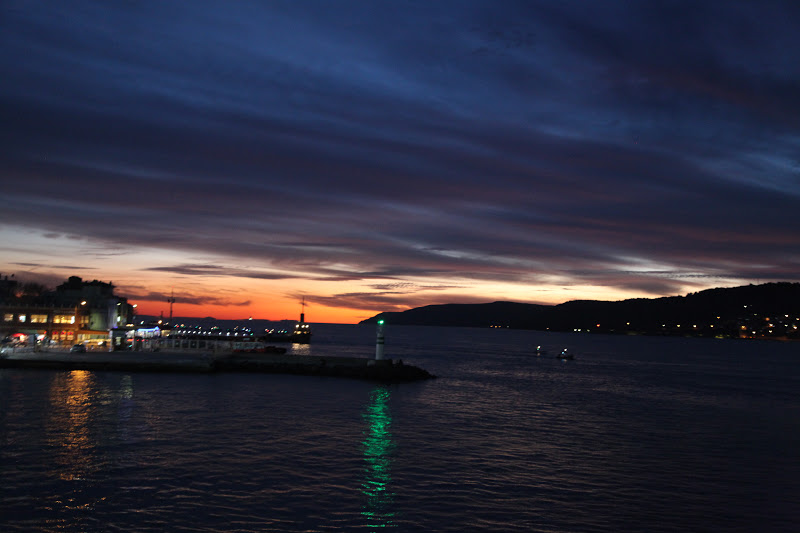
The Dardanelles from Canakkale
On visiting the RSL office to enquire about prices it was obvious there was no relation with the organization in Australia. As we climbed the stairs we were confronted by a smoke filled room with three middle age Turks in leather jackets in deep discussion.  Looking affronted at our entrance I brandished the RSL flyer in their general direction, which they grudgingly admitted was theirs, before simply stating ‘closed for the season’ and turning back to their discussions.  Slightly bewildered we retreated back down the stairs out into the street.

While they were closed a few more were open and I booked us onto TJ Tours which a Kiwi had recommended to us way back during our tour of Ephesus. I’d expected in wandering around Canakkale to find pockets of continued Australian and New Zealand presence roaming across the town. This was not to be however as it was evidently low season and with a maximum day temperature around 12 degrees it’s easy to understand why we appeared to be the only Gallipoli tourists in town.  That evening I did some further research and came across this excellent site prepared by the Australian Government on each of the key sites on the Peninsula.

The following morning on a crisp but clear day we caught the ferry across the Dardanelles to the town of Eceabat to meet up with our tour group who, except for us, were on a one-day round tour from Istanbul. On arrival the other participants to the tour were already absorbed in the Four Corners documentary on the conflict from 1988 ‘Gallipoli: The Fatal Shore’ that provides an engrossing lead in to the tour.

Brighton Beach looking north to ANZAC Cove
With this context we boarded our little bus for the short journey to Brighton Beach, the commencement of the tour.  On the journey our guide, TJ regaled us, maybe a tad too much, as to his credentials on leading such tours. 

On our first stop, and subsequent others after, what struck me most was what an unexpectedly picturesque location the English had chosen for the ANZACs to come ashore that fateful morning.  I’d never really associated Gallipoli with the same Aegean Sea that contains the many beautiful Greek Islands just off the coast, with its crystal clear waters and coastal heath vegetation.

Lone Pine
Over the course of the next three hours or so we visited a range of key sites such as ANZAC Cove, Lone Pine and various Australian and New Zealand cemeteries.  The cemeteries in particular felt very peaceful and slowly reading the inscriptions it’s apparent many of those killed were from country Australia.  Looking down from the Australian memorial at Lone Pine back to the sea it’s also starkly apparent what a pitifully small piece of land the Australians and New Zealanders occupied over the nine months of the campaign.

Ataturk
Another prominent aspect of the tour that came through was the key role Ataturk played in firstly rallying the Turkish troops to hold the Australian and New Zealand advance on the first day, that they only briefly surpassed once again over the whole campaign, and through the campaign, in leading his troops from the front. There is a great story of how during the August Allied offensive and Turkish counter offensive his life was saved from shrapnel by his pocket watch. It’s fair to say the history of the Turks over the past century would have been significantly different had he been killed that day.

Nineteen years after the Gallipoli campaign Ataturk gave a moving tribute to those from both sides of the conflict that lost their lives.  While the ANZAC campaign is long regarded as significantly contributing to the national identities of Australia and New Zealand it also significantly shaped and contributed to that of modern Turkey through the emergence of Ataturk as its leader.


Sunday, 25 November 2012

What's in a name


At each new town we’ve reached a familiar pattern has developed as we check into our latest accommodation.  Arriving at the counter I’ll introduce myself in the customary fashion by stating my name and that I’ve a reservation. 

Embracing my inner Turk, Grand Bazaar
At this point the eyes of the attendant generally light up and they’ll repeat back to me, ‘robert….TURK?’ and then search my face expectantly for some sign as to what mischief this is that someone should be named so.  I’ll then confirm this is indeed my name, eliciting almost the exact same response each time of, a question of genuine interest, ‘why are you called Turk, are you Turkish?’ Having responded to this question a number of times and aware now that the surname Turk is very uncommon in Turkey, I usually tackle the easiest part of the question first, clearing up that despite my pale freckly complexion I’m unfortunately (bearing in mind the other conversant) not Turkish.

Responding to the why is a tad trickier and I’ve tried a few differing approaches, …the literal – ‘well, my Father’s called Turk, and his Father…and I’m guessing his Father’s Father…etc’…knowing full well that’s not what they’re really asking…the urban myth with potential for truth response – ‘the name dates back to a period when my English ancestors would fight the Ottoman Turks and being handy in a fight return to England known as ‘Barry the Turk Fighter / Slayer / Bludgeoner’, that over time was shortened to Barry the Turk and eventually Barry Turk’…and finally the most disappointing of all responses…honesty – ‘I don’t really know’. To combat my absence of knowledge and the general disappointment my responses have bought I spent some time searching the Net and from this have concluded that despite a number of theories no else seem to know either.

Blue Mosque
So it was as I checked us into the Med Cezir Hotel in Istanbul I was faced with familiar questions, this time I elected the urban myth response, which prompted a mostly jokingly and slightly uncomfortable enquiry as to how many Turks Mr Barry must have smote in the past to be given such a name.

We were in Istanbul for 6 days, but with a population approaching 13 million we’re only really playing at the edges in terms of experiencing what the city has to offer. There was a strong feeling throughput our time there that the city is undergoing something of a renaissance in terms of its appeal as a global destination to both the western and Islamic worlds, and the continued increase in tourist numbers testify to this.

Door latch, Topkapi Palace
As They Might Be Giants sagely note however ‘Istanbul’ is only a relatively recent tag and represents its third title over a long and fascinating history. As the Greek, Roman, Byzantine and Ottoman Empires have rolled over this city at the confluence of Europe and Asia so they have all left their mark and influenced its current form. 

There are effectively three must see sights in Istanbul, the Hagia Sophia, Blue Mosque and Topkapi Palace and our little hotel in Sultanahmet (pronounced ‘Sultan-Ahmet’, as opposed to, ‘sultana-met’…which may or may not be how we pronounced it for several days) was literally 500m or so from all of them, an amazing location, although with the first Call to Prayer of the day at 5am it did feel on occasion like we were in the midst of a Blue Mosque slumber party.  

Hagia Sophia
All these are impressive monuments but what I liked most about the Hagia Sophia, constructed during the Byzantine period and at the time the greatest church in the world, is how the Islamic Ottomans on coming to power quickly converted the church through the addition of minarets and by altering the majority, but not all, of the internal facades for Muslim prayer, making them quite possibly some of the earliest adopters of green building philosophy. This conversion by the Ottomans of churches throughout Turkey contrasts sharply with the Spanish approach in Central and South America of seeking to destroy any edifices associated with the native religion.

Monday night, Tarlabasi Bvd
During the evenings we would escape the tourist fare and dinner touts in Sultanahmet and make our way across the Golden Horn to Beyoğlu, described as the bohemian area of the city.  It’s an interesting area, where formally derelict buildings are being converted into chic restaurants, cafes and bars.  It is however far from undiscovered and I can’t think of a street in another city like Tarlabasi Boulevard that forms the spine of the area.  Whether on the weekend or during the week it’s heaving with people strolling back and forth till all hours of the morning.  Walk two streets away however and it’s easy to find yourself, like we did, on completely deserted back streets and winding alleys.

But is it art? Istanbul Modern
While there are many existing attractions it’s also evident that Istanbul is in desperate need of a more uniform approach to public transport and inspiration in terms of urban design. The public transport system is a hodge podge of poorly connected single line heavy and light rail and metro, thrown together with the odd funicular that seems woefully underdone for the size of the city.  All that’s required now is a monorail to complete the pick n mix of approaches.  The Government is seeking to address this through the Marmaray project, but a visit to the Istanbul Modern, revealed that there is controversy surrounding this project in the process of acquiring land in slum areas where communities have developed but have no property rights. Our journey to Istanbul Modern, a great modern art museum on the banks of the majestic Bosphorus also highlighted the urban design challenges as once off the tram there’s no clear path to the museum and you wander aimlessly through rows of shisha bars until you reach a lovely bitumen car park and holding yard that marks its entrance.

As preparation for our next destination of Canakkale and the Gallipoli Peninsula on our last day I dragged Susi out to the Turkish Military History Museum for several hours.  The Museum is very affordable and in addition to the extensive collection of Ottoman period memorabilia there is a very detailed set of a diorama’s and displays on Attila the Hun. I’d never associated the antics of Attila with Turkey but it’s evident that the modern day Turk can trace their origins back to the horsemen riding out of the steppes of Central Eastern Asia and Attila was the first Turk who did so intent on giving the world a damn good thrashing.

Sunday, 18 November 2012

Buses from heaven


Like a small meteoroid orbiting the Earth we were being inexorably drawn towards the behemoth of a metropolis that is modern day Istanbul.  Unlike the meteoroid however our main mode of travel through Turkey has been the intercity bus. If heaven had an intercity bus service, and I’m sure being a fairly well populated place, it does, then I’d put a fair wedge of money on it being operated by the Turks.

Having had a variety of bus experiences over my travels there’s always a degree of trepidation when first encountering a country’s bus service, but from our first journey and each after we’ve been pleasantly surprised.  Not only are all the buses large intercity cruisers, but each seat has it’s own airplane style entertainment screen, it’s all in Turkish, but with most action movies it’s pretty easy to work out what’s going on, and most importantly, the good guys and the bad guys.  In some countries these features may be standard, but what sets the Turkish buses apart is the chap, normally resplendently dressed with sharp shirt and bow tie who provides complimentary cay, coffee, softies, water and cakes during the journey.
Safranbolu at dusk
It was on such a bus we left Goreme and Cappadocia behind, headed in the direction of Istanbul, but diverted from the direct route for three nights to the historical town of Safranbolu, near the Black Sea Coast.

Safranbolu (or ‘The Bowlo’ as I liked to refer to it, much to the amusement of only myself) is famed for its Ottoman era housing and back in the day, at the height of the Ottoman Empire, was reknowned for the quality of its craftsman and the herb it’s named after, saffron.  These days following the intervention of UNESCO the Ottoman era housing within the old city is slowly being restored and like most foreigners this is where we stayed.

Checking into our accommodation we were recommended a homely place to eat.  I was aware that we were now entering the low season, but walking around the old town at night there was barely another soul on the street.  The restaurant was easy to find as it was the one place where there were fellow humans. The restaurant itself was actually a converted house with two Turkish Mutti’s waiting in the kitchen for the husband to call through the order of one of the five items on the menu.  The food was delicious and it was great to have that home cooked taste to the meal.

Outside of the attractiveness of the old city there’s not a huge list of must see sights on offer.  I’d read through this blog that it was possible however to hike from the old city 7 km along a gorge to the Incekaya Aqueduct an ancient piece of Byzantine civil engineering, an irresistible combination. 

Scouting the net there wasn’t much on offer in terms of directions, and asking at the hostel only gave me the route for driving, the owner unable to understand why anyone would hike it. Trying Tourist Information the chap confidently pointed at the first bridge out of town over the gorge, indicated finding our way down into it and then, voila, simply hiking up it. 

Setting off we soon encountered the bridge spanning the gorge below.  After a bit of searching we found a way down to the dry creek bed within the gorge.  As I’ve previously noted rubbish collection isn’t a Turkish strong suit and a gorge represents God’s gift of a ready made landfill.  As we hiked amongst all sorts of debris including children's plastic toys the route just didn’t feel right.  Rounding a bend our way was completely blocked as the concrete bridge over the gorge had cracked and fallen into the gorge.  Backtracking and scrambling up we found ourselves not too far advanced and in the rear of a person’s property. 

At this point we decided the Tourist Information guy had no idea and proceeded along the parallel road for a couple of kilometers.  From what we’d read we were seeking wooden stairs down into the gorge that would take us to the ancient Aqueduct.  Crossing back over the gorge, now filled with a flowing creek, we continued merrily along, constantly wondering where these wooden stairs were.  Eventually the road petered out and we came across a group of guys with a car.  Asking for directions they also couldn’t understand why you would hike and indicated it was still quite some way to the concrete water bridge.

Incekaya Aqueduct
Obviously it was a busy day for them as we all then piled into their little van, two of us and four of them as they drove us to the Incekaya Aqueduct.  It turns out they were a group of civil engineers designing a new road and we were very grateful for their assistance.

Our Turkish guides

After revealing in the Incekaya Aqueduct and walking back and forth we decided to determine where we missed the decent into the gorge by following it back from the Aqueduct.  

Walking along we were soon joined by another group of Turks, three University friends and their Mother.  In exchange for them being able to practice their English they offered to show us the way, so guided by our new found friends we hiked our way back in the fading autumn light, reflecting on the generosity and friendliness of our chance encounters with locals on our hike.


Saturday, 10 November 2012

Cappadocia dreamin'

Something that’s become quite evident during our travels in Turkey has been the level of pride the Turks have in their country. This pride is most overtly recognisable through the multitude of Turkish flags waving proudly in all manner of locations across the country, although surprisingly they’re yet to embrace the superman cape look for some reason.

More subtly this pride is demonstrated through popular culture.  While enjoying a cup of cay (the ever present black Turkish tea) in a Pamukkale café the Turkey current top 20 were playing on a nearby TV.  As we watched it became apparent that all the songs were by Turkish artists, which generally involved the warbling of a swarthy chap and there wasn’t the slightest hint of western infiltration.

Within this context we’ve been constantly amused by how this song has infiltrated Turkey and the unusual places it’s cropped up, such as watching the sunset at an outdoors bar in Antalya, only for the background hum of the city to be broken by a group of guys walking by with a small radio blasting it out, or more recently as we biked along a narrow track through the Rose Valley on the outskirts of Goreme in Cappadocia, only to have to take evasive action and move smartly off the path as an ancient white Renault packed with barely teenage boys came racing along and, like an agitated octopus, their arms pumped the air to the tune out of the car windows as they passed by in a cloud of dust.

Goreme and the wider Cappadocia area perhaps goes someway to explaining the source of the Turkish pride.  As with Pamukkale it’s unique, being famous for the alien landscape of pendulous outcrops and wavy ice-cream shaped rocks cascading down hillsides into valley floors. The formations are a result of hardened volcanic flows that have remained as the surrounding earth has eroded overtime to reveal the rock underneath.  During the Byzantine period the local communities started to construct dwellings, stores and churches in the rocks and below ground to protect against marauding raids from the Persians.  These days the main use of the houses in the rocky outcrops (beside hotels) is as pigeon coups, that we were informed assists in providing much need soil fertiliser for the surrounding farms.

We’d somewhat upgraded our accommodation in Goreme following Kizkalesi and opted to stay in the Kelebek ‘special’ (special in that all the hotels have the word cave in them so there’s a need to differentiate) cave hotel.  It was a lovely place to stay nestled into a rocky outcrop overlooking the town of Goreme.  Each morning from our cave room you could hear the faint sound of the firing of the balloons outside the window and peering out the window watch them slowly rise to join with the 70 or so other balloon rides that occur each morning.
Morning over Goreme
'Love' Valley
On checking in we’d been given a sketchy map of the surrounding valleys, outline of the walks and approximate time to spend in each one, including the modestly named ‘Love Valley’ (30 minutes apparently)….and Rose and Red Valleys.  After a day spent walking around the valleys we decided it’d be easier the next day to head back with bikes.  Many people drive quads around the valleys, but from what I observed it becomes more about racing over sand dunes than taking the fascinating homes amongst the landscape.

The sketchy maps provided by the hotel seemed to be the same available throughout the town and we set off on our bikes to the Rose and Red Valleys trying to relate the squiggles on the paper to our surrounds.  To confuse matters there regularly appeared red spray painted arrows to the valleys that work for a while, but then start to contradict each other.

The tops of the valleys are sparsely vegetated, but lower down the vegetation increases and winds with the valley floor.  Being late autumn the leaves had turned a golden yellow and in the weak sunshine it was great fun to ride along the path.  At some stage however we must have missed that the path turned off the trail we were on as I never actually imagined that the trail came out of the valley floor we were in and went over the top of the valley as I learned later on.  Consequently we blindly rode on as our path became increasingly narrow and came across the first location where we had to pick the bikes up and haul them over rocks. 
As we continued on this became a common occurrence, with the path only wide enough for the bike handles and the walls of the valley looming over us.  Eventually we reached a point where the path split in two, one way the path disappeared completely and the other the path was blocked by a boulder larger than I.  At this point we came to the startling conclusion that we’d somehow taken a wrong turn and retreated back the way we’d come.  We spent the rest of the day riding around other valleys, stopping to dismount and climb up to explore the insides of the long abandoned houses before pedalling our exhausted bodies back before the setting sun.

We end up staying in Goreme for five nights, doing a day tour of surrounding ruins and an underground city that spread to a depth of eight floors beneath the ground, but felt that we’d only just scratched the surface in terms of exploring the unique Cappadocia region.


Thursday, 1 November 2012

The Turkish Mole

Since our arrival in Turkey we’d had something of a purple patch in terms of our time in the country; Ephesus, the Travertines and our cruise from Fethiye to Olympos, were all memorable experiences.  As Lance Armstrong can attest however it’s naturally hard to keep a run like this going and the week following our cruise was to demonstrate this.

On reflection I think the downward slide can be attributed to a Mole in our ranks and its cunning leverage of the Turkish four day Islamic, Kurban Bayrami (the merrily named ‘Festival of Sacrifice’) holiday period. This year it also coincided with Turkish Republic Day and so represented a fair chunk of holiday time for the Turks.
Worried of Turkey

A key aspect of the Festival is the slaughtering of a halal animal (cow, goat, sheep or even a camel) by each family and the distribution of the body parts in equal portions to close family, friends and those less fortunate. From our observations the goat seemed to be the slaughteree of choice on the western Mediterranean and with approximately 77 million Turks, over 96% of who are Muslim this equates to a lot of worried goats.

Like any good shyster the Mole gained our confidence over a long period and did so again through its whisperings and pointed insights about not staying in Olympos, the default post cruise location, but rather Cirali, a mere 3km further along the beach front.

Chimera
Whereas Olympos is effectively a series of backpacker hostels coming off a dirt track, Cirali is its own town set in a forested coastal strip ringed with small rural holdings and overlooked by the surrounding mountains. With free bikes available from our hotel we spent an enjoyable afternoon pedalling around before pulling over and enjoying the local speciality of pomegranate and orange juice in one of the many vegetated grotto like eateries.

Cirali is also closer to the primary attraction in the region, the ‘chimera’, a naturally occurring phenomenon whereby volcanic gases exude from the rocks on the side of a mountain and are ignited through contact with the atmosphere.  Setting off at dusk we hiked through the town and surrounding countryside to watch the sunset as the flames flickered from the rocks all around us.

Kaleici, Antalya
Our plans from Cirali had been informed by prior research that pointed to accommodation and spots on any bus being hard to come by prior to, during and after the Bayram holiday period.  To manage this, and on advice from the Mole, we’d chosen to spend four nights in Kizkalesi on the eastern Mediterranean as we tried to wring the last vestiges of heat out of the remnants of the Turkish summer.

Our journey to Kizkalesi took us through the historic city of Antalya for an evening, which should have provided us with our first warning signs about the Mole as the directions provided were all over the place for moving in and out of the city from the bus station.  We had however no reason to question its advice and once we’d made it to Kaleici, the historic Roman centre of Antalya and despite the turning of the weather, could have easily spent more than an evening, but the scarcity of buses meant we were on the move again the next day.

It wasn’t until our bus rolled into Kizkalesi that the extent of the betrayal the Mole had wrought upon us was apparent.  For the first day or so neither of us could bring ourselves to openly discuss this betrayal as we found it hard to believe that it’s vivid description and promotion of the town as ‘wonderful’ could be so far from the truth.

The Kizkalesi the Mole, or as it is otherwise known, Lonely Planet, had described was a far cry from the mosquito infested, litter strewn concrete jungle by the sea we encountered.  With its intermittent electricity supply and roaming packs of wild dogs and mangy cats we would normally have moved onto the next location, however with accommodation and bus spots at a premium due to the Bayram holiday we were locked in for four nights.

During this time I came across an earlier description of the town stating it was in danger of losing it’s character due to the mushrooming of B and C grade concrete block hotels. Well it has lost that battle and also the one to control its approach to waste disposal. 


More broadly this appears to be a particular problem in Turkey and even on our cruise we’d be fishing out large plastic water containers as we swam around.  Within this context I couldn’t help but think on hearing the news over the past few weeks that Afghanistan has declared its first national park, with a view to attracting tourism in the future, that I hope they consider and provide the infrastructure to handle the unintended environmental impacts that rapid tourist development can bring, lest such development destroy the values that attract tourists in the first place.

Thursday, 25 October 2012

Crystal clear


I think you’d be hard pressed to find another country that has such genuine love and appreciation of another human than the Turks do for Mustafa Kemel, or Ataturk (meaning Father Turk) as he is more commonly known. Reading through the history of his life and role in shaping modern Turkey it’s easy to understand the source of this admiration. For the Turks there’s no question as to who is the Daddy and the only other country I can think that has a similar relationship is the Vietnamese reverence for Ho Chi Minh.

Today the physical actualization of this admiration is borne out through, at minimum; an Ataturk statue in every town, his name adorning every imaginable piece of infrastructure and his benevolent gaze staring down from behind the counter of any commercial enterprise you may come across.

Kayakoy
While we were on the coast in Fethiye to commence our four day gulet cruise to Olympos we had enough time to visit the eerily deserted ghost town of Kayakoy, a consequence of an Ataturk policy in the 1920s to avoid future sectarian conflicts and ensure a Turkish republic solely for Turks through population exchanges.

It’s a short minibus ride from Fethiye to Kayakoy, but for the unsuspecting, such as us, the ride passes through the ultimate chav dream resort of Oludeniz, where a full English roast is available everyday of the year and neon lit establishments, such as the bemusingly named 'Grand Boozey', do a thriving trade.  Like most Turkish sites once you’ve paid a nominal entrance fee you’re free to climb on, over, up and down unhindered and so we spent an enjoyable afternoon clambering over the former Greek speaking town whose population was forced to depart for Greece under the population exchange program.

Scouring the list of available tourist activities in Turkey I’d quickly singled out the desire to spend several days puttering along the Turkish coast line in a hand made traditional wooden Turkish ‘gulet’ vessel.  It’s a popular activity with numerous operators and having singled it out I was also responsible for choosing one. Fortunately I was saved this task through the fruits of my side project of chatting with elderly American men in unusual locations around the globe. A conversation with a retired professor from the University of Nebraska following a swim in the hotel pool in Selcuk revealed he’d done his research and chosen V-Go. On this basis we found ourselves with thirteen others assembled outside the V-Go office in Fethiye ready to board our cruise one warm clear morning.

The mighty Mavi Boncuk
Any group activity with a bunch of strangers, and especially one in an effectively confined space for four days, there’s concern you’ll be stuck for days on end with a bunch of nuff nuffs.  As we motored out of Fethiye aboard the ‘Mavi Boncuk’, (replete with suitably benevolent Ataturk portrait) to our first stop, the stunning beach at Butterfly Valley wedged between two mountains, these fears were quickly allayed and over the course of the next four days I was constantly surprised how well our group, consisting of mainly Americans and Australians, gelled. 

Part of this could have also been down to the clear crystal waters, the feeling timeless sunny hot days brings and a sea so calm that most of the time it resembled a deep blue liquid chrome.  Combined with the realisation that there was nowt to do except swim, converse, laze on the deck, wonder if it was too early for a beer and enjoy the next sumptuous meal prepared by the crew, it’d take a miserable soul indeed not to gell with your fellow travellers. Even Tony managed a smile, well, more a grimace, but it's a start.

The following morning our gulet slowly made its way along the coast towards the Kekova region where we’d spend the next few days, overnighting initially at the beautiful secluded town of Kas, set in a bay at the base of a coastal mountain range, and the next at another still calm bay.  During the day we’d drop anchor and snorkel, or, as in case of the small community of Simena, part of a historical city sunken into the sea by an earthquake, be offered the chance to go ashore.

Butterfly Valley
The water clarity visibly highlighted however the extent of overfishing along the course of our voyage. While in 2006 WWF convinced the local authorities to declare most of our route a marine park, the sea felt largely bereft of marine life, with all but the tiddliest of tiddlers absent at depths up to 10m. It was startling and made me question a number of times the source of the fish in the numerous seafood restaurants dotted along the coast.

With my initial reservations completely unfounded it was in the end all too soon that we were saying goodbyes at the port of Demre and back into the swing of bus travel for our next destinations, and like most we were headed for the Olympos region. 

Saturday, 20 October 2012

Round Turkey with a market trolley


During our time in Kos it became apparent that since the start of my travels several months ago I’d had my backpack set up was all wrong. The length was way too short, so that instead of resting on my hips I had all the weight on the top of my back. A schoolboy error I know, and one that eventuated during our time in Greece to a constant pain in my back between my shoulder blades, making carrying any weight an uncomfortable experience.


Departing Kos for Bodrum in Turkey, a short hydrofoil across the deep blue seas, it was apparent that if we were to backpack around Turkey, with its extensive intercity bus network, and bus stations, I’d need to find a solution for hauling my luggage that didn’t involve my back.  After contemplating purchasing suitcase with wheels Susi came up with the idea of modifying an older ladies market day trolley.

Bodrum
Picturesque Bodrum fancies itself as the St Tropez of Turkey, with a host of high-end stores and flash restaurants, over looked by the imposing Castle of St Peter, the stronghold of the Knights of St John in the 1400s.  Perversely it also promotes itself as a Centre of Excellence in imitation clothing to the hoards of Kos daytrippers that peaks with the weekly Tuesday textile market. We headed in that direction in search of a suitable market trolley and quickly spied one outside a hardware store across from the market. After insulting the proprietor with my haphazard bartering I became the proud owner of a market day trolley and three occie straps for securing the backpack. 

While Greece and Turkey aren’t on the best of terms (although Turkey has a solid track record with this on a few fronts…Syria, Armenia, Iraq, Iran…), there are similarities, such as large groups of men sat around doing not very much. 

In Turkey these groups seem to be focused on perfecting their backgammon game and contemplating the strength of the latest round of tea, while presumably their female relations, wife, mother, daughters, are at home hard at work.  In such a culture the sight of a man pushing a market day trolley is a source of high merriment amongst the local male population as I found alighting from the plush bus from Bodrum to Selcuk.

Selcuk is the closest town to the ruins of Ephesus, the eastern capital of the Roman Empire after it split into west and east, and despite the masses of annual visitors retains its authentic Turkish flavour, in part due to a vast majority of Ephesus visitors bussing in on a day trip from the cruise town of Kusadasi.  Ephesus is one of the best preserved Greco-Roman cities and while, like Tikal in Guatemala, only 20% of the site has been uncovered, is a fascinating site to visit.

Ephesus
After several days in Selcuk including a highly informative guided tour of Ephesus, punctuated with obligatory stops at a traditional pottery and carpet store to be charmed by smooth talking Turkish salesmen we were back on the bus to Pamukkale, who’s correct pronunciation is a constant mystery to me. 

Where Selcuk has retained its own sense of being outside of the tourist drawcard Pamukkale has rolled over, put its feet in the air and accepted its fate as service town to the Travertines (or Cotton Castle as the Turks refer to it), the amazing white calcified pools that have formed on the side of a mountain at the base of the ancient city of Hierapolis.

Waiting till later in the afternoon to visit I was pretty stunned by how much I enjoyed our time clambering over the calcified mountain and wading into the naturally warm turquoise pools. I think my enjoyment sprung from the uniqueness of the Travertines, never having experienced anything like it before we were both donning wide smiles as we slowly ventured up the mountain, stopping numerous times to wade into the warm water pools as they appeared on the side of the path. 

While visually you feel as if you’re in the midst of a snow field, you’re conflicted by other senses which feel the Turkish heat and glare and the ribbed white surface beneath your feet that is like you’re walking on the surface of giant cats tongue, albeit one that's been licking a bowl of bleach. Following a fleeting visit to Hierapolis we returned once again to the Travertine’s to enjoy the descent at dusk and early evening.
The Turkey Lonely Planet rates the Travertine’s as the 17th top experience in Turkey, with eating a kebab coming in at 5th…I think it would need to the crème del la crème of kebabs, maybe prepared by Ataturk himself to top this experience.

The next morning I prepared the market trolley once more and trundled to the bus station for our next destination and experience, Fethiye and a Gulet cruise.